
Phillips County Court Records After Arrest
After a Phillips County jail arrest, the arresting agency creates the arrest or booking record and the prosecutor decides what formal charges to file. The court record is the case file and docket activity created after that filing decision. It may show the case number, court dates, charge descriptions, bond events, plea settings, disposition, and sentencing entries. It does not prove the person is still in jail.
For custody status, use jail inmate records, the Phillips County Sheriff's Office, Logan County Detention Center, or VINE. For booking photos, use the jail mugshots process. For court records after a jail arrest, use Colorado Judicial docket search, Phillips Combined Court, and, when full documents are needed, a court records request.
Find Phillips County Court Records
The Colorado Judicial Branch docket search is the free official search for hearings and docket information. It is not a full case-document portal. The research notes that at least one filter beyond date is required, so a useful search should include Phillips County, the 13th Judicial District, party name, case number, courthouse, or court type.
- Open Colorado Judicial docket search.
- Select Phillips County, the 13th Judicial District, or Phillips Combined Court when those filters help narrow results.
- Search by defendant name, business name, case number, attorney, or date plus another filter.
- Read the docket for hearing dates, filed charges, bond events, and case status.
- Contact Phillips Combined Court or use Judicial records request channels for copies of pleadings or orders.
The Colorado Judicial public records guide explains that full court record access is not provided directly through the public website. Records can be requested from the court where the action was filed, through an online request, or through approved vendor register-of-actions access.
The official Colorado docket search is the main public lookup point for Phillips County court records after arrest.
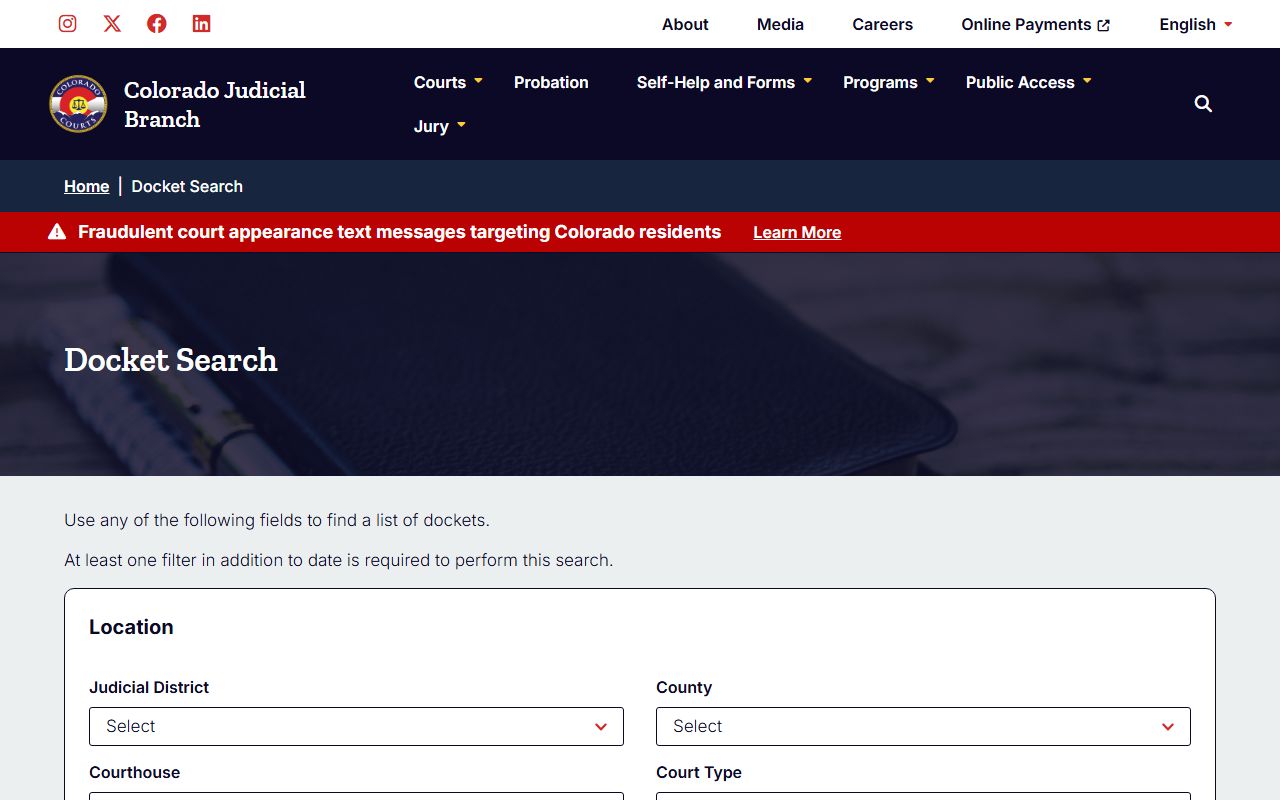
Use the docket to find hearings and case activity, then request documents from the court if the register alone is not enough.
Charges Filed After Arrest
Booking charges can differ from court charges. Booking charges describe the arresting agency's initial basis for custody. Court charges are the counts filed by the 13th Judicial District Attorney after review. In Phillips County, the DA's office prosecutes state felony and misdemeanor crimes across the 13th Judicial District, which includes Kit Carson, Logan, Morgan, Phillips, Sedgwick, Washington, and Yuma counties.
| Document | Filed By | What It Does |
|---|---|---|
| Complaint | Often officer or prosecutor | Starts many criminal cases with initial allegations. |
| Information | Prosecutor | Common felony charging document filed after review. |
| Indictment | Grand jury | Grand-jury charging document, less common in routine cases. |
Phillips County DA Decisions
The 13th Judicial District Attorney's Office identifies Travis Sides as District Attorney and Rebecca Wiard as Assistant District Attorney. The DA site explains that deputy district attorneys review cases brought by local law-enforcement agencies, compare reports with current law, and make filing decisions. Plea negotiations may weigh speedy-trial rights, case strength, victim wishes, public safety, punishment, rehabilitation, and deterrence.
Washington County's official DA contact page directs residents of Logan, Phillips, Sedgwick, Washington, and Yuma counties to the Sterling Office at 110 N. Riverview Road, Sterling, CO 80751, phone 970-522-2973, with weekday hours from 8 a.m. to 5 p.m. That office is separate from Phillips Combined Court in Holyoke.
Charge Status in Court Records
Phillips County court records after a jail arrest often change as the case moves. A charge may be pending at first, then amended, reduced, dismissed, deferred, or resolved by plea, trial, or sentence. A docket entry is a point-in-time record, so read each count and each later entry before assuming the final result.
| Status | Meaning |
|---|---|
| Pending | The charge or case has not reached final disposition. |
| Amended | The prosecutor changed the count, language, or charge level. |
| Reduced | A lesser charge replaced a more serious count, often through negotiation. |
| Dismissed | The count or case ended without conviction on that charge. |
| Deferred judgment | A plea with conditions that may lead to dismissal or sealing eligibility. |
| Conviction | A judgment of guilt by plea or verdict. It is not the same as an arrest. |
Bond After Phillips County Arrest
Colorado bond law is mainly in Title 16, Article 4. C.R.S. 16-4-103 addresses the purposes of bail determination, and C.R.S. 16-4-104 lists types of bond the court may set. After a Phillips County arrest, first confirm where the person is held, then ask which court set bond and where payment must be posted. Bond may be handled through the court or jail depending on timing and local practice.
| Bond Type | How It Works | Local Caution |
|---|---|---|
| Cash or secured bond | Money must be posted before release. | Verify whether court or jail accepts payment. |
| Surety bond | A bail agent posts bond for fee or collateral. | Colorado permits commercial bail bonding agents. |
| Personal recognizance | Release on promise to appear, sometimes with conditions. | Supervision or other terms may still apply. |
| No-bond hold | Money bond will not release the person. | Requires court action or another agency clearance. |
Warrants and Missed Court
No official Phillips County active-warrant search or most-wanted page was located. For local warrant questions, call the Phillips County Sheriff's Office or contact Phillips Combined Court for the case. The Colorado docket search can show hearings, missed-court events, and case numbers, but it is not a complete warrant database.
An arrest warrant authorizes arrest based on probable cause or a charging document. A bench warrant is often issued for failure to appear or violating a court order. A fugitive warrant or outside hold may keep a person in custody after local bond is posted. Do not treat a docket search result as a release decision. Ask the jail and court which hold controls custody.
Charges vs Convictions
A Phillips County arrest, a filed charge, and a conviction are different legal events. An arrest is a custody event. A charge is an accusation filed in court. A conviction is a judgment of guilt by plea or verdict. Public court records may show all three, but each entry has a different meaning.
| Charge | Conviction | |
|---|---|---|
| Stage | Accusation filed in court | Final judgment after plea or verdict |
| Proof | Not proof of guilt | Judgment of guilt |
| Can change | May be amended, reduced, or dismissed | May affect sentence, custody, probation, or appeal rights |
Sealed Arrest Court Records
Colorado sealing rules, including C.R.S. 24-72-704 to 24-72-706, can restrict access to arrest and criminal-justice records when no charges are filed, cases are dismissed or acquitted, or convictions are eligible. The Colorado Judicial Seal My Case page is the official self-help starting point. Sealing is not the same as removing every copy from the internet.
| Sealed | Expunged | |
|---|---|---|
| Public access | Restricted from ordinary public access. | More limited and usually tied to specific record types. |
| Law enforcement | May still have lawful access in defined settings. | Depends on the record and statute. |
| How to start | Use Colorado Judicial forms and eligibility rules. | Use the specific Colorado process for eligible records. |
Restricted Court Records After Arrest
Some court and criminal-justice records are not fully open. Colorado criminal-justice records law allows redaction or denial when disclosure is prohibited by law or contrary to public interest. Sexual assault victim identifying information must be removed before release to non-criminal-justice requesters. Juvenile records, sealed records, active investigations, victim information, and certain personal identifiers may be restricted.
Important: Public court records are not consumer reports and may not be used for FCRA-covered screening decisions.